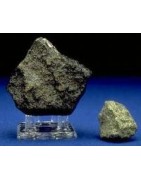
Nakhla is one of the most historically significant Martian meteorites and the type specimen of the nakhlite group. It fell in 1911 near the town of Nakhla, Egypt, making it one of the earliest well-documented meteorite falls later recognized as originating from Mars.
Mineralogically, Nakhla is composed predominantly of clinopyroxene (augite) crystals embedded in a fine-grained matrix. Its igneous textures indicate crystallization from basaltic magma, followed by slow cooling in a shallow magmatic environment on Mars. The meteorite is particularly notable for preserving clear evidence of secondary aqueous alteration, providing some of the earliest direct clues to the presence of liquid water on the Martian surface.
As the reference specimen for nakhlites, Nakhla occupies a central position in the study of Martian meteorites. Its mineralogy, textures, and alteration features have played a key role in establishing the volcanic and hydrological history of the Martian crust.