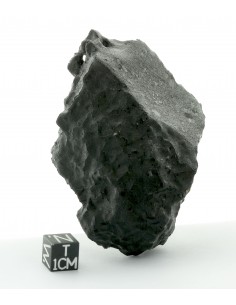
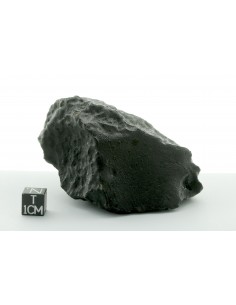
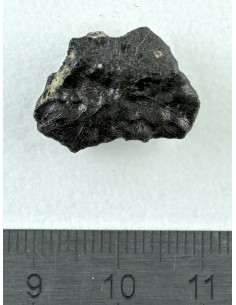
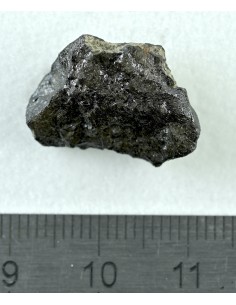
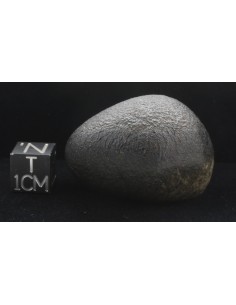
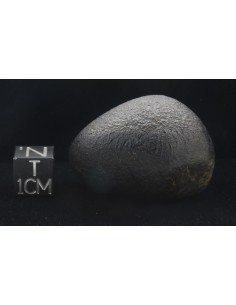
Oriented Martian meteorites are among the rarest expressions of atmospheric entry recorded in extraterrestrial materials. These specimens originate from Mars and preserved a stable aerodynamic orientation during their passage through Earth’s atmosphere, allowing heat and ablation to sculpt them into distinctive natural forms.
Unlike randomly tumbling stones, oriented Martian meteorites developed a clearly defined leading face, often marked by flow lines radiating from a single apex, and a contrasting rear surface shaped by differential ablation. In some cases, a shield-like morphology or subtle roll-over rim may be observed, reflecting prolonged stable flight under extreme thermal and mechanical stress.
The occurrence of orientation in Martian meteorites is particularly exceptional with the preservation of a coherent aerodynamic shape. When present, these features provide a rare physical record of atmospheric entry dynamics superimposed on material originating from another planetary body.
As fragments of the Martian crust, these meteorites combine planetary geology and aerodynamics in a single object. Each oriented Martian specimen preserves both the deep-time history of Mars and the final moments of its journey to Earth, shaped by natural forces acting under extraordinary conditions.