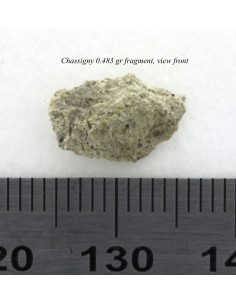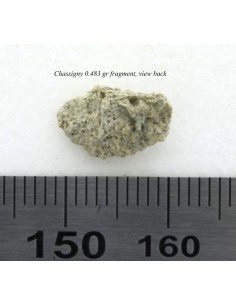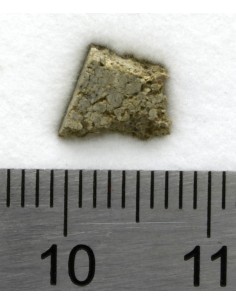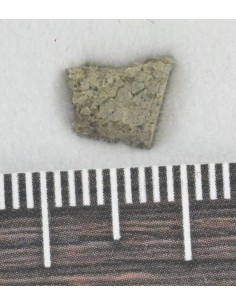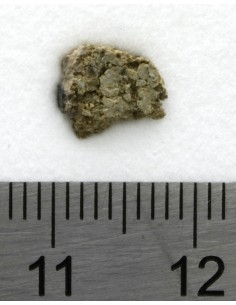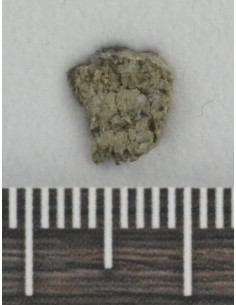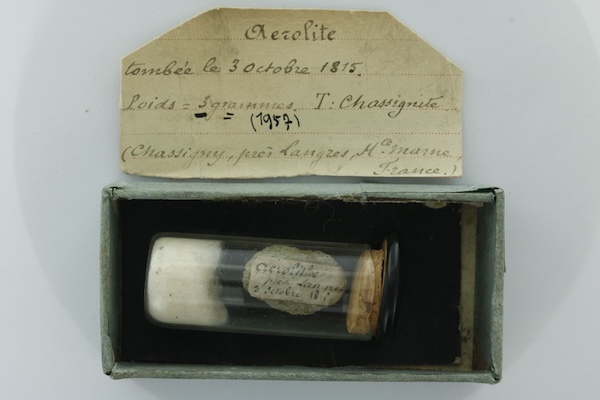
An exceptional 3 g fragment of the Chassigny Martian meteorite, preserved in its original 19th-century glass vial, complete with handwritten labels.
Remarkably, the specimen itself retains a label affixed directly to the fragment — a practice typical of early scientific collections. Beyond its Martian origin, this piece represents a rare and authentic testament to the history of meteoritics.
Chassigny is a Martian meteorite of exceptional historical and scientific importance. It fell on October 3, 1815, near the small town of Chassigny in Haute-Marne, France, making it one of the earliest well-documented meteorite falls in history.
Eyewitnesses reported loud sonic booms preceding the fall, after which a stone was observed descending from the sky and impacting the ground. The meteorite originally had a mass of approximately 4,000 grams (about 9 pounds). Over the two centuries since its fall, most of this material has been distributed for study or lost, and only about 570 grams are preserved today, primarily within the collections of the Muséum national d’Histoire naturelle (MNHN) in Paris.
Chassigny is a Martian meteorite distinctly different from shergottites and nakhlites, the two other main groups historically associated with the SNC meteorites. Its unique mineralogical and geochemical characteristics led to the recognition of a separate subgroup, now known as chassignites, for which Chassigny is the type specimen.
Chassignites are characterized by their olivine-rich composition, interpreted as representing material derived from the Martian mantle rather than volcanic rocks formed at the surface. This makes Chassigny a key reference for understanding the interior composition and early differentiation of Mars.
As both a historically significant fall on French soil and a cornerstone of Martian meteoritics, Chassigny occupies a singular position among planetary materials. Its rarity, limited surviving mass, and role as a type specimen place it firmly within the domain of institutional reference collections and advanced scientific study.