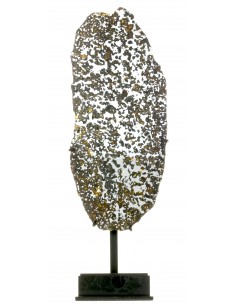
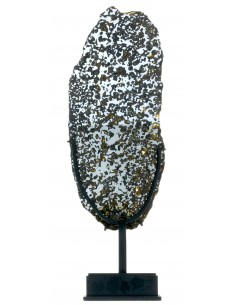
Lov 263 is a unique pallasite discovered in January 2018 in the Atacama Desert, Chile, within the Los Vientos collection area. This meteorite is known from a single recovered stone, personally found by Luc Labenne during a meteorite hunting expedition conducted in parallel with the filming of a documentary on meteorite recovery.
At first glance, the specimen did not resemble a typical meteorite. Its unusual appearance and unexpected density immediately suggested an atypical origin. Close examination shortly after recovery revealed the presence of silicate crystals embedded within metal, strongly indicating a pallasitic nature. Subsequent laboratory analyses confirmed this initial field assessment.
Lov 263 is classified as an ungrouped pallasite, distinguished by an exceptional mineralogical composition. Unlike classical pallasites dominated by olivine, this meteorite contains approximately equal proportions of metal, olivine, and pyroxene, a combination that is extremely rare among known pallasites.
Geochemical and mineralogical analyses conducted by R. Hewins and S. Pont (MNHN Paris), J. Gattacceca and C. Sonzogni (CEREGE), and M. Humayun (Florida State University) demonstrate that Lov 263 is distinct from main-group pallasites. Oxygen isotope measurements (δ¹⁸O) clearly separate this meteorite from established pallasite groups. In addition, the metal phase is characterized by kamacite containing approximately 5.7 wt% Ni, a composition that further differentiates Lov 263 from other known pallasitic metals.
These combined characteristics led to its formal classification by R. Hewins (MNHN) as a Pallasite (ungrouped), a designation that reflects both its uniqueness and its scientific importance.
Lov 263 stands as a rare example of how field discovery, careful observation, and subsequent laboratory study can reveal entirely new expressions of planetary materials. It occupies a singular position within pallasite studies, bridging metal–silicate meteorites and more complex lithological assemblages.